
How the Hoot Works
Understanding Aerobic Wastewater Treatment
The Hoot advanced aerobic treatment system uses a multi-stage biological process to produce clean, clear effluent — right inside the tank, before anything reaches your drain field. Here’s exactly how it works.
Aerobic vs. Conventional Septic Treatment
To understand how the Hoot works, it helps to first understand what makes it different from a conventional septic system. A traditional septic tank relies on anaerobic decomposition — a slow, oxygen-free process that breaks down some of the solids in wastewater but leaves the effluent only partially treated. That partially treated liquid then relies heavily on the soil in the drain field to complete the treatment process before reaching groundwater.
The Hoot system takes the opposite approach. By actively introducing oxygen into the wastewater inside the tank, it creates an aerobic environment where highly efficient bacteria thrive and rapidly break down organic material to a much higher degree. The result is effluent that is dramatically cleaner when it leaves the tank — requiring far less from the soil and drain field to finish the job.
Achieved inside the tank through aerobic biological treatment — before effluent ever reaches the drain field.
Near-complete suspended solids removal produces clear, odorless effluent suitable for approved dispersal methods.
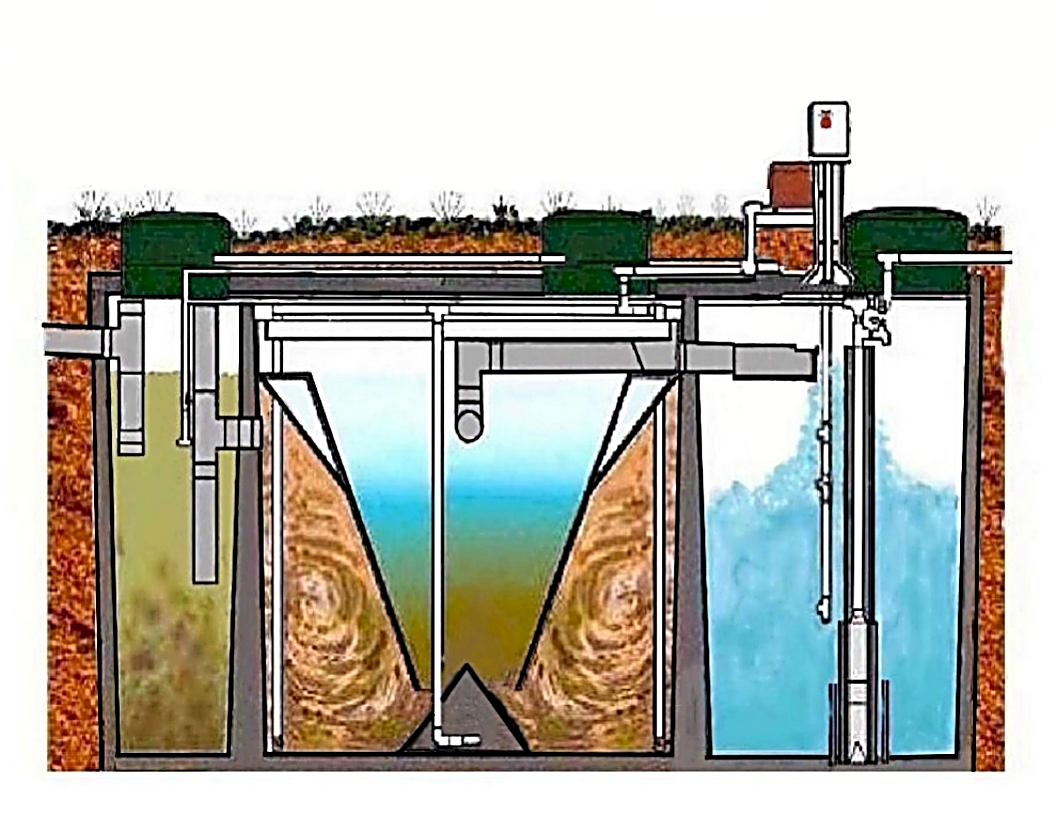
HOOT H600 BNR — Hover or Tap a Zone to Learn More
Move your cursor over any highlighted zone on the diagram to see what that component does. On mobile, use the list below the diagram.
Stage by Stage — What Happens Inside the Hoot
The Hoot BNR system processes wastewater through four distinct chambers, each serving a specific role in the overall treatment sequence. All four chambers are contained within a single concrete tank.
Stage 1 — Pre-Treatment Chamber
Wastewater from your home or facility enters the pre-treatment chamber first. Here, heavier non-biodegradable solids settle to the bottom and are retained, while initial anaerobic decomposition begins to break down some of the organic material. This stage prepares the wastewater for the more intensive aerobic treatment that follows.
Stage 2 — Aeration Chamber
This is the heart of the system. An above-ground linear air blower continuously pumps oxygen into the wastewater through a diffuser system, creating an oxygen-rich environment that supports a dense, active population of aerobic bacteria. These bacteria rapidly attack and break down organic material — far more efficiently than the anaerobic process in a conventional tank. Nitrogen-fixing bacteria in this chamber also begin converting ammonia into nitrate, initiating the nitrogen reduction process.
Stage 3 — Final Clarifier
Wastewater from the aeration chamber moves into the final clarifier, a calm settling zone where any remaining activated sludge settles to the bottom. As solids settle, clear treated effluent rises to the surface. The settled sludge is continuously recirculated back into the aeration chamber, where it rejoins the active bacterial population and continues contributing to the treatment process.
Stage 4 — Pump Chamber & Discharge
Clear, treated effluent from the clarifier flows into the pump chamber, where it is stored before being discharged through your county-approved dispersal method — typically a GeoFlow subsurface drip system. A portion of the daily flow is also returned to the pre-treatment chamber, where exposure to the incoming anaerobic influent promotes additional denitrification — converting nitrates into nitrogen gas that safely off-gasses from the system.
UV Disinfection
For sites requiring the lowest possible pathogen levels — whether due to county requirements, proximity to water supplies, or planned reuse applications — UV disinfection can be added between the clarifier and the pump chamber. UV light effectively neutralizes pathogens in the treated effluent without the use of chemicals, bringing fecal coliform counts below 100 and supporting compliance with the strictest discharge and reuse standards.
UV disinfection is standard on the Hoot ANR system and available as an option on BNR configurations where site or county conditions require it.
How the ANR Takes It Further
The Hoot ANR (Advanced Nitrogen Reduction) system builds on this same four-stage process and adds a patent-pending carbon dosing system that achieves significantly greater nitrogen reduction. A computer controller monitors actual system flow and doses a carbon-based additive proportionally, promoting additional denitrification and driving total nitrogen levels below the EPA’s 10 mg/L drinking water standard.
This makes the ANR the right choice for nitrogen-sensitive sites, properties with minimal soil separation from groundwater, and any application where the highest available treatment level is required. Learn more on the Hoot ANR System page.
Getting It Right from the Start
The Hoot system’s performance depends on correct sizing, proper installation, and accurate system startup and verification. Airflow rates, electrical connections, probe placement, and discharge timing all need to be set correctly for the system to achieve its certified treatment results.
Superior On-Site Solutions supports Hoot projects from system selection and equipment supply through installation coordination, system startup and verification, and ongoing O&M service. We work alongside the project’s qualified professionals and licensed installation contractor to help ensure the Hoot equipment is properly installed and configured for final approval.
- Correct system sizing based on actual site flow and loading requirements
- Proper electrical connection and control panel configuration
- Airflow calibration for optimal aeration chamber performance
- Discharge timing and return flow settings verified at system setup.
- Owner orientation so you understand your system and know what to watch for
- Ongoing O&M service to keep performance consistent and maintain compliance
Want to Learn More About the Hoot System?
Whether you’re evaluating a Hoot system for a new project or want to better understand the system you already own, we’re happy to answer your questions. Call us or send a message and we’ll get back to you promptly.